

Barry F#$%@*G Lyndon
When the Algorithm is the Narrator


Three hours. Powdered wigs. A man walking slowly toward his own ruin. People talk about Barry Lyndon like it’s homework. It’s “beautiful” in the way museums are quiet, distant, too polite to touch. Barry Lyndon is beautiful the way a trap is beautiful. Every candlelit frame is a velvet-lined box being lowered into the earth. The camera doesn’t chase excitement; its chasing inevitability. And once you understand that, the movie stops feeling slow and starts feeling mercilessly calm, the way the ocean is calm when it has already decided what it’s going to do to you.
The Invisible Voice
What makes it addictive isn’t the wigs. It’s the narrator.
The narrator speaks like the future has already been filed away. Like Barry’s life is a matter of record. Like we’re not watching a man make choices so much as watching a world process him. It’s the voice of a system that doesn’t hate Barry and doesn’t love him either. It simply knows what happens to men like that.
That’s the real subject of the film: not Barry, but the structure that can swallow a person and still look elegant doing it.
The Seduction of Inevitability
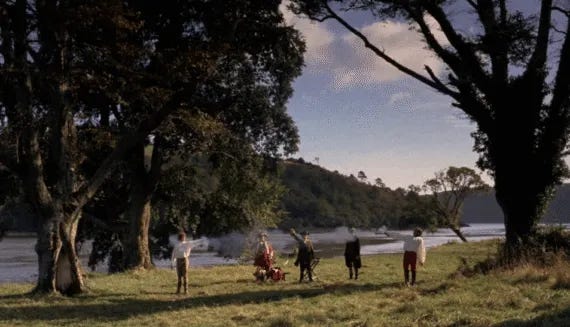
A lot of people think fatalism, a belief which considers the entire universe as a deterministic system to refer to the view that we are powerless to do anything other than what we actually do. But the deeper, more unsettling version of fatalism is not “everything ends.” but your fate was sealed from the beginning.
Fatalism is a world where the frame arrives first, and the human being shows up late, trying to negotiate with a structure that doesn’t negotiate. In that kind of world, you can still laugh. You can still love. You can still win small victories. Barry indeed does that but he also makes you see the ceiling. It makes inevitability feel warm. It makes it feel like candlelight. It makes the cage feel expensive. That’s why the movie is so dangerous: it doesn’t warn you. It lulls you. You settle into the beauty, and then you realize the beauty is part of the mechanism.
Kubrick films inevitability the way a coroner files a report: with chilling, gorgeous calm.
The Framing of Barry and his Luck
Barry Lyndon is built from three things: History. Class. Narration.
They exist before Barry. They’ll exist after Barry. They are older than his desire and stronger than his imagination. No matter how he tries to impose his will on the world. He wants status, so he learns the manners. He wants safety, so he finds the right rooms. He wants legitimacy, so he chases the symbols of legitimacy. The film watches him do this with an almost scientific patience, like we’re observing an organism trying to adapt to an environment that will not adapt back.
It understands something we don’t like to admit. A lot of what we call “choice” is just the shape of the room we’re in. When people say Barry “fails,” they imply he could have succeeded if he were better. Smarter. More disciplined. Less reckless.
But Kubrick’s fatalism is colder than moral judgment. It’s not “Barry is bad.” It’s “Barry is processed.” Which means the tragedy isn’t that Barry makes the wrong choices. It’s that the system was always going to read his choices the same way.
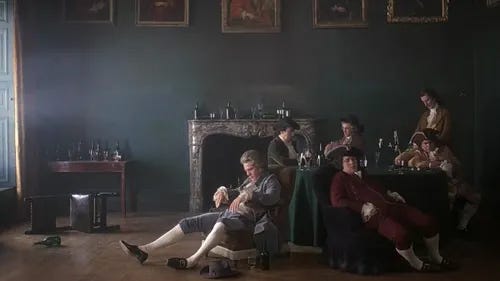
The New Narrator
If Kubrick’s narrator is history speaking through a voice, then our modern narrator is history speaking through numbers. It’s not aristocracy, at least not in powdered wigs. It’s not a narrator with a British accent telling you what happens before it happens.
It’s quieter than that. More intimate. More constant. It’s “For You”.
The “For You Page” is a prophecy machine. Not because it predicts the future—because it trains you to accept the idea that the system already knows what you are.
It decides what is seen, what counts as real, what you cannot avoid, and no matter what you choose everything is archived, receipted, weaponized.
TikTok and Social Media doesn’t tell you what happens. It decides what happens. Not always because you want to. Because the platform teaches you, over time: if you don’t fit the pattern, you don’t exist.
And when something hits, people rewrite your entire identity as if it was inevitable: “I knew you were gonna blow”, “This was always your lane.”, “You were born for this.”
But if it doesn’t hit, the same work becomes proof of your irrelevance:
“Maybe your content isn’t it.”, “Guess it wasn’t meant for you.”, “Try something else.” Same effort. Different outcome. One system. No explanation. The feed turns distribution into essence. That’s fatalism disguised as feedback.
Metrics become a language for reality. Views become legitimacy. Retention becomes truth. Shares become worth. Saves become legacy. Your art becomes evidence for the case the algorithm is building about you.
And because everything is recorded, the judgment never dies. It just gets reposted. This is the surveillance economy’s hidden psychological tax: you start living like your future trial is already scheduled.
Hip-Hop and Fatalism
Hip-hop has always been fascinating here. It has always been the art of negotiating with structures designed to limit you. But listen closely, and you can hear the negotiation changing.
The modern system doesn’t just distribute your music. It distributes your identity. A viral moment becomes a life sentence. A 15-second snippet becomes your entire career. A hook becomes your permanent narrative. When that happens, the artist isn’t just battling the streets or the industry. They’re fighting the chorus of the system itself.
Hip-hop remains the great art of self-definition, but now that act of self-definition happens on a platform that profits from simplification. And simplification is a direct cousin of fatalism. It turns a person into a type. A moment into a destiny.
This matters because hip-hop’s journey mirrors a deeper, more painful negotiation. It began as a platform for a community—a tool for expression and elevation from nothing. It has become a consumer hub for the consumption of that community. There is something profoundly fatalistic in that arc: people using their God-given talent to articulate their reality and better their situation, only to have the system selectively elevate only those it can most efficiently monetize.
This is the TikTok mechanism applied to a centuries-old story: you must prove your value to the algorithm, to the marketplace, on its terms. For Black artists in America, this creates a unique, double-layered fatalism. Your fate within a society that has already decided much for you is sealed, unless you can re-prove your value to that system—often at the expense of being simplified, stereotyped, or divorced from the very community you speak for. The system doesn’t just process you; it demands you become a digestible product to escape its default verdict. No other American art form or community wrestles with fatalism on these precise, compounded terms: artistic, economic, and racial, all at once.
Final Thoughts
So that’s the case: Barry Lyndon isn’t a period piece. It’s a blueprint. It shows you what fatalism looks like when it wears velvet—how a system can narrate a man into meaninglessness while pretending it’s just “history.” Kubrick’s genius is that he makes the trap feel like comfort. He makes the verdict feel like candlelight.
The narrator used to be a voice. Then it became a number. Now it’s a feed. A dashboard. A permanent record. We don’t need an aristocracy to tell us what we are—we have metrics, and the metrics have a language: seen / ignored, elevated / buried, real / irrelevant.
And there’s one narrator even older than the algorithm: a date.
Because a date doesn’t argue. A date doesn’t explain. A date arrives preloaded with meaning and asks your life to fit inside it. That’s where I’m going next. September 13th, 2004 isn’t about what happened on that day—we all know what the world says happened. It’s about what it means to be alive inside a day that history already owns, and still insist your story counts.
👏🏽