

Death F#$&*!G Stranding (Part One)
The mail still comes. Something else doesn't.

I remember Alex.
Not like you remember a person. Like you remember a landmark. He was just part of the block the same way the corner store was part of the block. You didn’t think about why he was there you just knew he was supposed to be. Old heads spoke to him. Mothers spoke to him. Guys who didn’t speak to anybody spoke to him. He knew your street name and he knew your government name and on this block that means something. Twenty years he ran that route. Twenty years of showing up rain snow or whatever drama the neighborhood had going on that morning and nobody ever had to think twice about it. A few weeks ago he retired. Rode off. And I’ve been sitting with what that means ever since because I want to do anything for twenty years the way Alex did that route. As a filmmaker as a writer as something. I remember seeing him as a kid and now I’m a grown man and he’s gone and the mail still comes but something doesn’t.
I didn’t think a video game let alone Death Stranding was going to help me figure out what.
But here we are. Yes we are talking about a video game. Alex if you’re reading this — hope retirement is treating you right.
CHAPTER 1 : BRIDGES
I remember my old professor seeing me play this game because I was passionate about getting through the a delivery before I went to my Lake Placid screening. I remember her saying what is the point "its just walking" and at that moment I thought about it and at the time I just chucked it down to she didnt get it but in reality it was hard to describe the experience with this game. I agreed it was mostly walking but what kept me going? The actors were amazing but intentionally disconnected. The plot was convoluted but had no holes. The game was gorgeous but there was nothing to see. The gameplay was tedious but thoughtful. Everything about it should have made me put the controller down.
So why couldn’t I?

For me it starts with what the game was trying to do. Death Stranding did something deconstructive — it made a game that was quiet, minimalist, empty and slow. A direct contradiction to everything the industry was selling. Colorful. Fast. Loud. Jam packed with content. Live service slop designed to keep you on the hook forever. I was starving for something that felt like a single player experience again and Death Stranding gave me that and then some.
I remember climbing a mountain. Rain hitting Sam’s jacket. Navigating the map, hiding from storms, running from nightmarish creatures that existed somewhere between a ghost and a nightmare. All the things that make a game were there but I never once felt like I was in a gameplay loop. I felt like I was on a journey. Then Bones by Low Roar started playing and something happened to me that I didn’t expect from a video game. It was chilling. It was inspiring. It stuck with me the way certain songs stick to certain moments and refuse to let go.
That’s textbook film theory dressed as a video game. Deconstruct a standard. Subvert a genre. Create a new experience. At the very least Kojima tried to redefine what a game could be. At the very most he succeeded.
CHAPTER 2: THREADS
The plot is convoluted. Kojima goes out of his way to explain every detail of his world leaving no stone unturned, and somehow with all that explanation there isn’t a single plot hole. But what’s profound isn’t the plot. It’s the weight. Every cutscene, every delivery carries it. The game makes you carry your dead mother on your back. Yes literally. It makes you deliver a pizza to the man trying to end the world without telling you that’s what you’re doing. You feel the cost of everything you carry including the connections you make. That’s not an accident. That’s the whole point.
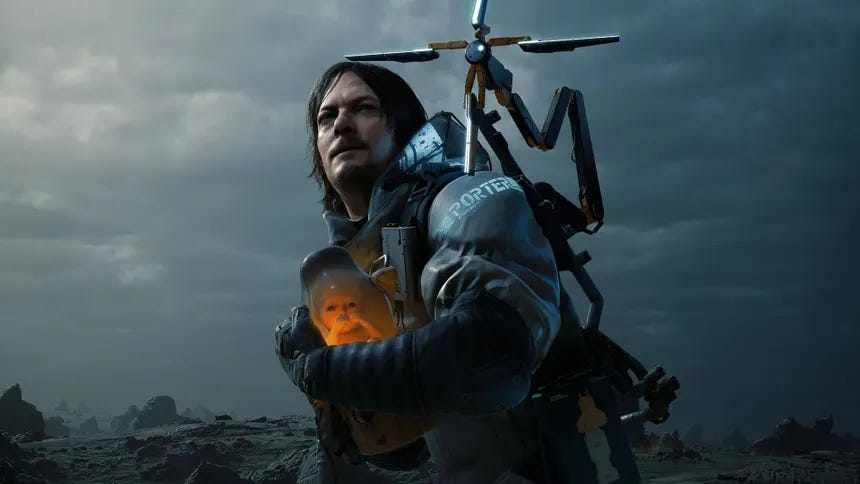
Sam Porter Bridges — played by Norman Reedus — is a porter. He connects scattered outposts of a broken America together by delivering survival resources. He works for a company but moves alone. No connections by choice. Then he gets a task to reconnect America from east to west to stop an apocalyptic event called the Death Stranding. What struck me immediately was how optimistic Kojima was about America. The imagery is soaked in Manifest Destiny — the vast empty landscape, one man crossing it alone, civilization waiting on the other side. But underneath the romanticism is the critique. America in this game is scattered, divided, people cut off from each other and from the internet and from any sense of shared purpose. That’s not a hot take. That’s Tuesday.
What makes it profound is Sam. He connects people regardless of race, background, or what they believe. The outposts aren’t connected to each other. They’re connected through him. Through the act of showing up and delivering and moving on to the next one. Through twenty years of doing the route.
Sounds familiar.
CHAPTER 3: CONNECTIONS
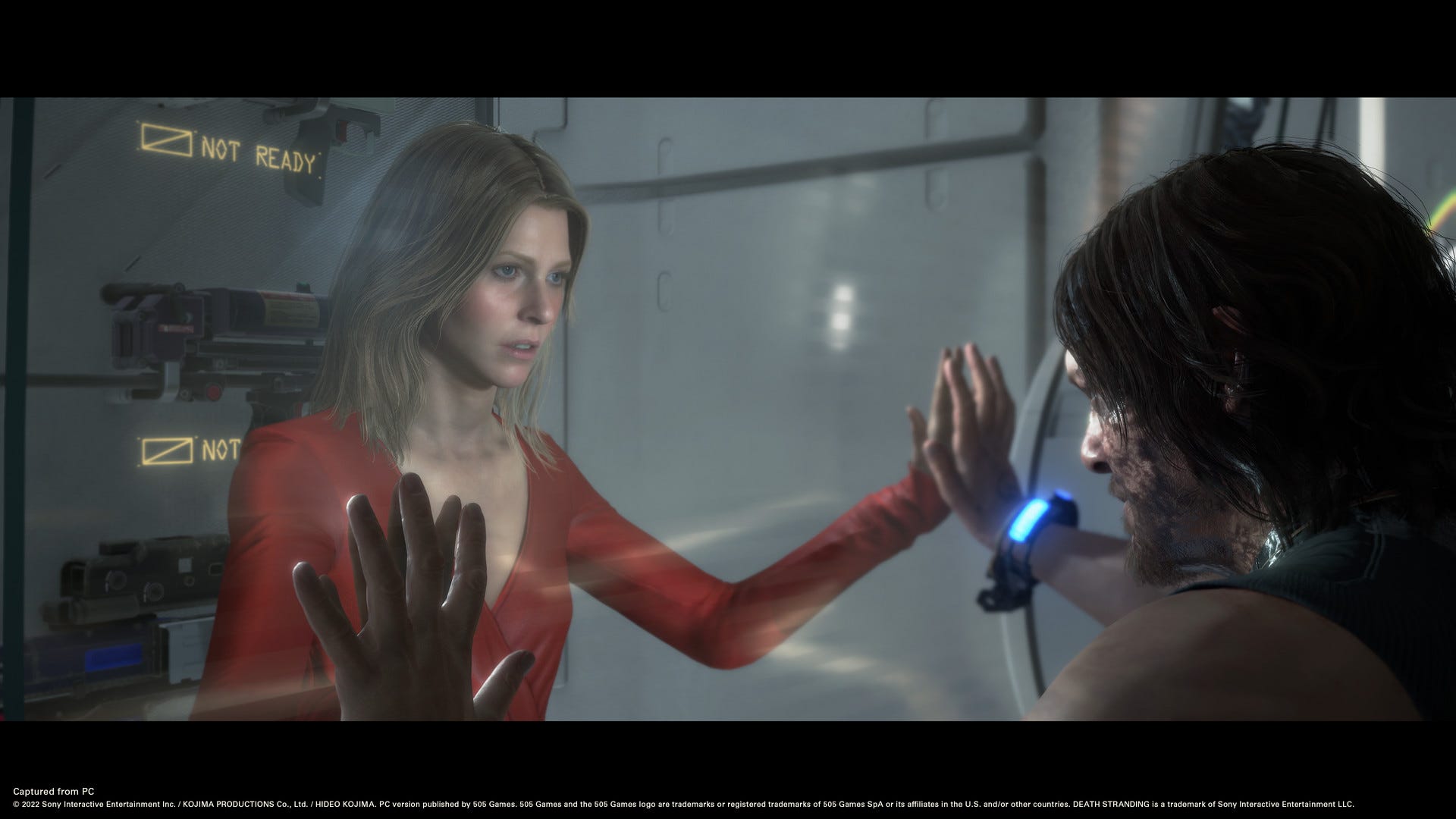
The graphics are hands down some of the most beautiful landscapes I have ever seen in any medium. Not just any game. Any medium. Mountains. Snow and rain falling on Sam’s jacket in real time. The Decima Engine is a genuine technological achievement, `nd Kojima used all of that beauty to render a map that is almost entirely empty.
That’s the move. A barren America left for you to build and connect however you see fit. Roads. Bridges. Ziplines. How America gets reconnected is entirely up to you. The infrastructure doesn’t exist until you make it exist. The connection doesn’t happen until someone decides to carry something through the rain for a stranger they will never meet.
This game checks every box of what should have been a massive American hit. The cast. The graphics. The world building. The studio behind it. The response was lukewarm. And I think that disconnect was exactly the point Kojima was making.
Because the disconnect isn’t between the player and the game. The disconnect is between what America craves and what America needs.
Alex delivered what America craved. Medicine. Packages. Checks. The daily mail. But what he also delivered — what he provided that nobody put in the job description — was connection. The bridge between our community and the rest of the world. The thread that held the block together without anyone asking him to hold it.
Death Stranding understands that distinction. America in the game craves to be brought back online. But what it needs is connection. The dots only connect because a person made the effort to reach across the distance and touch them. Sam does it across a broken country. Alex did it across our block for twenty years.
That’s why this is one of the most precise critiques of American society I’ve seen in a video game. And the only other game that comes close is Metal Gear Solid 4.
Also a Kojima game. Make that make sense.
CHAPTER 4: CARRIES
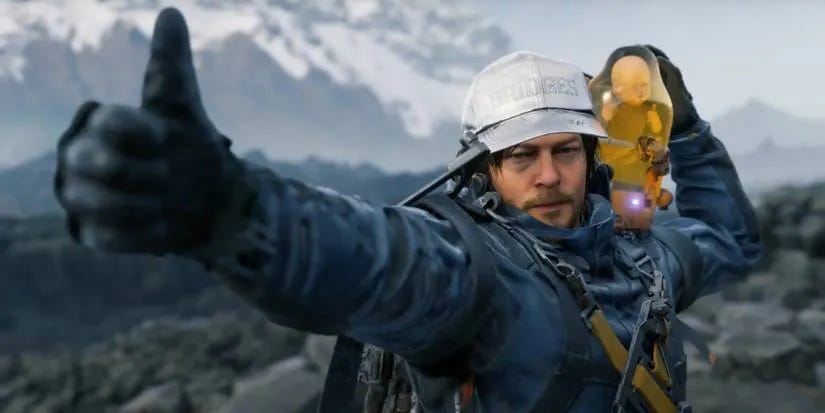
Will we ever connect the way Kojima believed we could? My cynical brain says probably not. But there’s something worth sitting with in the fact that a man in Tokyo looked at broken, divided, exhausted America and saw something worth saving. Saw something worth making a twelve hour game about. Saw the potential in us that honestly I couldn’t always see in myself until recently.
Maybe we should meet that optimism halfway.
A different carrier delivers my mail now. The route is the same. The packages still arrive. But Alex is gone and the neighborhood didn’t know what it needed until it left with him. The infrastructure survived. The connection didn’t.
That’s the story of Death Stranding. That’s also the story of the block.
PART TWO: On April 29th. The robots replaced the porters. What Death Stranding 2 understands about what we lost.