

The Distance Between Two Pictures
A conversation with a woman in Iran about what lives in the space between a selfie and a body bag.

[This piece is based on anonymous testimony from an Iranian woman. Some details are paraphrased or generalized to protect her identity. Where claims cannot be independently verified, they are presented as lived perception rather than established fact.]
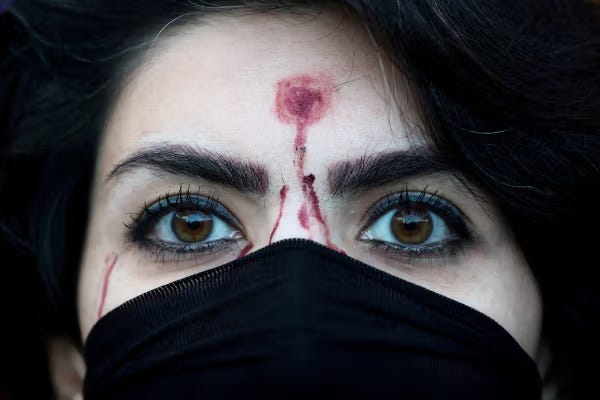
I’m scrolling.
You’re scrolling.
A graduation cap tilted sideways. A mirror selfie with bad lighting. A group of friends pressed together, smiling too hard because the picture will last longer than the moment. Youth documented mid-breath. Proof of life.
One swipe later, the image changes.
It’s blurry. The resolution drops. Black plastic catches the light in a way skin never should. The shape underneath is human only because we know it is. A body bag doesn’t need a face. There’s no transition screen. No warning. Just the cut.
The distance between those two images is a chasm. A scream in the silent space between heartbeats. An Iranian woman told me that this distance is not an accident. It is the most important thing she wants the world to understand. It is, in her words, what stands between joy and death, between a future and a funeral. It is manufactured.
She tells me this is the distance she lives inside.
An Ordinary Day Without Ordinary Days
She says the idea of an “ordinary day” stopped making sense years ago. Not because every day is chaos, but because chaos became routine.
For her, and for millions, the concept of an “ordinary day” shattered years ago. It did not vanish, but it mutated. Now, an ordinary day is a series of practiced rituals of evasion and endurance. It is turning on a VPN with the same automatic motion used to boil water for tea, because the free internet is a ghost you must conjure. It is scanning headlines not for news, but for tremors in the ground beneath your feet. It is carrying a cocktail of joy and un-erasable memory in your heart, trying to move forward with what she called “a broken heart and hope for better days.” The ordinary is not the absence of crisis; it is the method of navigating it.
She checks the news not out of curiosity, but to see what kind of day it will be. Whether the economy has collapsed again. Whether another protest has been crushed. Whether someone didn’t make it home.
Another part of that daily navigation is a quiet, monumental choice. For her, it is walking out the door with her hair uncovered. Imagine, for a moment, that your choice of what to wear—a hat, a scarf, nothing at all—was not an expression of style, but a calculated risk. That the consequence for your choice could be violence, imprisonment, or death.
“Every day I walk out with my hair bare knowing that it is justified for [The Regime] to kill me or splash acid on my face for my choice,” she said.
This isn’t about a piece of cloth. She knows the risks. She’s not naïve about them. That’s what makes it a ritual instead of a protest. She says many women made the same choice. Quietly. Together. Knowing exactly what it could cost.
It’s about who gets to decide what a body is for—and who it belongs to. People where she lives are known for laughter. For filling rooms with warmth. She says that part is still true. But it sits on top of something heavier now—memories that don’t fade, names that don’t leave, grief that becomes a companion instead of a wound.
The Slow Violence of an Empty Wallet
She talks about dreams the way you talk about old apartments—places you once imagined living, now clearly out of reach. Buying a house. Owning a car. Planning more than a month ahead.
The pressure is not only in the air; it is in the wallet, in the stomach. She speaks of an economy that has turned dreams into folklore. Buying a house or a car is “an out of reach sort of dream.” People wear less Not as a style choice, but because clothes last longer when you don’t replace them. They eat less Not fasting—rationing. Stretching meals. Adjusting expectations downward until hunger becomes background noise. This is poverty not as a temporary hardship, but as the very atmosphere you age inside, thickened by pollution, drought, and the constant, gnawing anxiety of “what might happen.” It is a slow, comprehensive violence.
Layered on top of this are things that sound abstract until you live inside them: air so polluted it burns, water that runs short, electricity that disappears without explanation. Darkness that isn’t symbolic. It’s just dark. Poverty is a haunting feature of a climate you age inside.
Hope That Comes Like a Storm
And yet—this is the part I keep returning to, the part I didn’t expect—she says hope still comes. Not as a whisper. Not as a careful calculation. It doesn’t wait for an opening.
“People become the most hopeful every time there is a protest,”
She describes it almost as a reflex, a psychological law: hope spikes precisely when the risk is greatest. When protests flare, something in the atmosphere cracks. The word revolution is spoken, and in its wake comes not calm, but a terrifying, galvanizing clarity. This hope isn’t reassuring. It’s febrile.
You can see it in bodies before you hear it in chants, she tells me. Shoulders go back. Spines find a forgotten alignment. It’s as if, in the act of gathering, people suddenly remember the shape they were meant to hold. They stand differently. They breathe differently. The private weight they’ve been carrying is momentarily lifted, not because it’s gone, but because it’s seen—shared, held in common.
It’s uncanny, she said. Almost frightening.
Because this variety of hope offers no promises. It doesn’t swear everything will be okay. It burns too hot for platitudes. This isn’t the optimism of the oblivious; it’s the stark, clear-eyed resolve of people who have a full accounting of the horror—and who refuse to let that knowledge paralyze them.
Paradoxically, this hope doesn’t bury the trauma. It exhumes it.
Everything that’s been swallowed—the fear, the rage, the silent humiliations—ruptures into the open. Private ache becomes public truth. In that recognition, in the locked eyes across a street, there’s a jolting realization: I am not alone. I am not crazy. I am not weak for being bent by a force designed to break me.
The pressure lifts for a moment, not because the danger has vanished, but because it has been named. People remember that their feelings are rational. That their grief is a logical response to loss.
And that is what makes this hope so dangerously volatile. It doesn’t pacify; it disrupts. It sabotages the slow, insidious work of normalization—the daily training that teaches you to accept less oxygen, less dignity, a smaller future. It’s a reminder of the wanting itself.
The hope, she insists, isn’t in some distant victory. It’s in the act of resistance. Full stop.
It’s in showing up. In standing shoulder-to-shoulder and seeing the same defiant light in a stranger’s eyes. It’s the fleeting, vital proof that relentless pressure has not yet crushed the human spirit into mere endurance. That it can still crystallize into something harder, sharper.
Even when it burns. Especially when it costs. Even if, by morning, it’s gone.
The Engine of the Distance
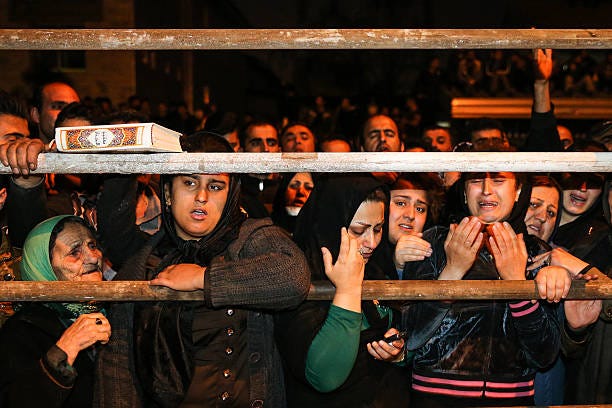
She doesn’t describe what she sees as chaos. She describes it as consequence.
In her telling, the space between the smiling face and the body bag is not an accident, not a tragedy that slipped through the cracks. It is a predictable output. Something produced. Something generated by design.
She sees a system that rules without consent and without accountability, where decisions are insulated from the people who must live with their results. In that system, violence is not a breakdown—it is a tool. Fear is not collateral damage—it is infrastructure. The distance between joy and death is not random; it is calibrated.
She says the language of chaos is comforting because it implies no one is in control. But what she lives inside does not feel uncontrolled. It feels administered.
The distance is not an act of God.
It is a matter of policy.
When she speaks about responsibility, she does not speak abstractly. She names leadership. She names the Islamic Republic. She names Ali Khamenei—not as a cartoon villain or a symbol to chant against, but as the center of gravity in a system where obedience is rewarded and life is expendable.
In this system, she says, accountability never travels upward. It moves in one direction only—downward, onto bodies. Onto young people. Onto women. Onto anyone who disrupts the fiction of order by insisting on dignity.
She doesn’t frame this as ideology. She frames it as cause and effect.
A protest is met with force. Force creates fear. Fear disciplines behavior. When it doesn’t, it escalates. Each step follows the last with mechanical certainty. The outcome—injured bodies, disappeared people, sealed coffins—is not a failure of governance. It is the result governance was built to produce.
This is why the distance feels so large to her. Not because it is mysterious, but because it is deliberate.
She lives inside a system where smiling faces are tolerated only as long as they do not demand a future. Where youth is celebrated in photographs and punished in reality. Where the body becomes a site of enforcement, and death becomes an acceptable expense.
This isn’t a slogan to her. It’s the logic of what she lives through. And once you see that logic, the distance between the two images stops being shocking. It becomes familiar. Which may be the most frightening part of all.
Collapsing the Space Between “There” and “Here”
Here’s why we are here on a snowy day.
She is not a headline. She is not a symbol. She is not “a woman from the Middle East.” She is my friend. I don’t know if she will ever read this. I hope she lives long enough to.
It is easy—so easy—to read this and think of it as a tragedy happening “over there.” To feel a pang of sympathy for a woman in a headline, in a region often reduced to politics and conflict. This is the distance she is asking us to collapse.
She is a person who holds specific memories—of laughter, of loss, of people she loved who didn’t come home. She makes coffee, checks her phone, and carries a social trauma so profound she says calling it “trauma” is putting it mildly.
She is someone’s daughter. Someone’s sister. Someone’s best friend.
If she lived on your block, you would recognize her laugh. You would borrow sugar from her. If she went missing, the space she left would have a shape.
The Swipe
The distance between you and her is not geography. It’s the luxury of forgetting.
You will close this tab and return to the scroll. The digital procession of lives will continue. But perhaps now, you will feel the distance differently. She told me she lives between two pictures: healthy, happy youth on one side, black body bags on the other. She believes the space between them is made of power.
Somewhere, a woman just wants to live. To wake up. To choose her clothes. To eat enough. To imagine a future without calculating the cost to her body.
She lives in the space between those images, wearing her hope and her grief side by side—waiting for the world to stop pretending such a distance is natural.
Author’s Note:
This piece was written with the consent of the person whose experiences shaped it. It is published anonymously to protect her safety. I am sharing it not to explain a country or argue a position, but to stand beside a friend who wants to live.
Amazing writing. Chills the entire time. You really paint a vivid picture with your use of metaphor and diction.
Thank you for writing and sharing this piece.