

Minstrels: America’s Longest-Running Media System
How Minstrelsy Shaped Modern American Media

We like to tell ourselves a story about American media: that it began neutral, was later corrupted by bad actors, and is now slowly correcting itself — more diverse, more objective, more fair.
History suggests something less comforting.
American mass media did not drift into racial distortion. It emerged inside a racial order. From its earliest mass entertainments, it helped construct and circulate a durable fiction called “Blackness” — a set of images, traits, and expectations that stabilized white identity and justified inequality. That system did not disappear as media evolved. It adapted. The name for its earliest form was minstrelsy.
The Profitable Negro
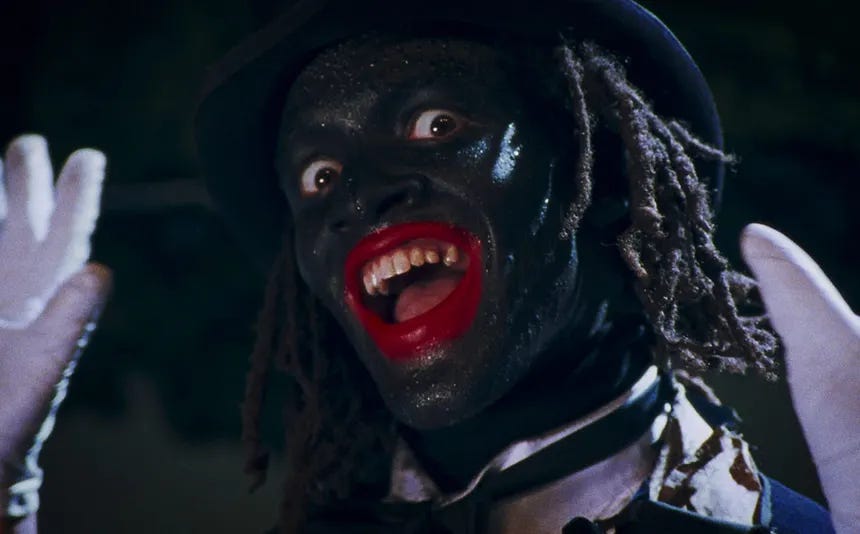
It would be inaccurate to claim that American media has ever served only one function. It has always been commercial, artistic, political, and occasionally reformist at the same time. But in the American context, these functions repeatedly converged around racial hierarchy.
Nineteenth-century blackface minstrelsy was not marginal entertainment; it was a national industry. Touring circuits, sheet music, and printed iconography turned caricature into mass culture. As historians such as Eric Lott have shown, minstrel performance allowed white audiences — particularly working-class audiences navigating industrial change — to negotiate anxieties about status and identity through racialized humor.1
Commerce did not soften this logic. It rewarded it.
That pattern extended into advertising. Brand figures such as Aunt Jemima and Uncle Ben were not casual stereotypes; they were carefully engineered mascots that transformed minstrel archetypes into product trust. As Marilyn Kern-Foxworth and Maurice Manring demonstrate, racial caricature helped sell domestic stability during periods of profound social upheaval.2 The imagery reassured consumers that hierarchy remained intact.
Commerce and racial myth were not separate forces. They reinforced one another.
Cinema Is Born Racist (Literally)
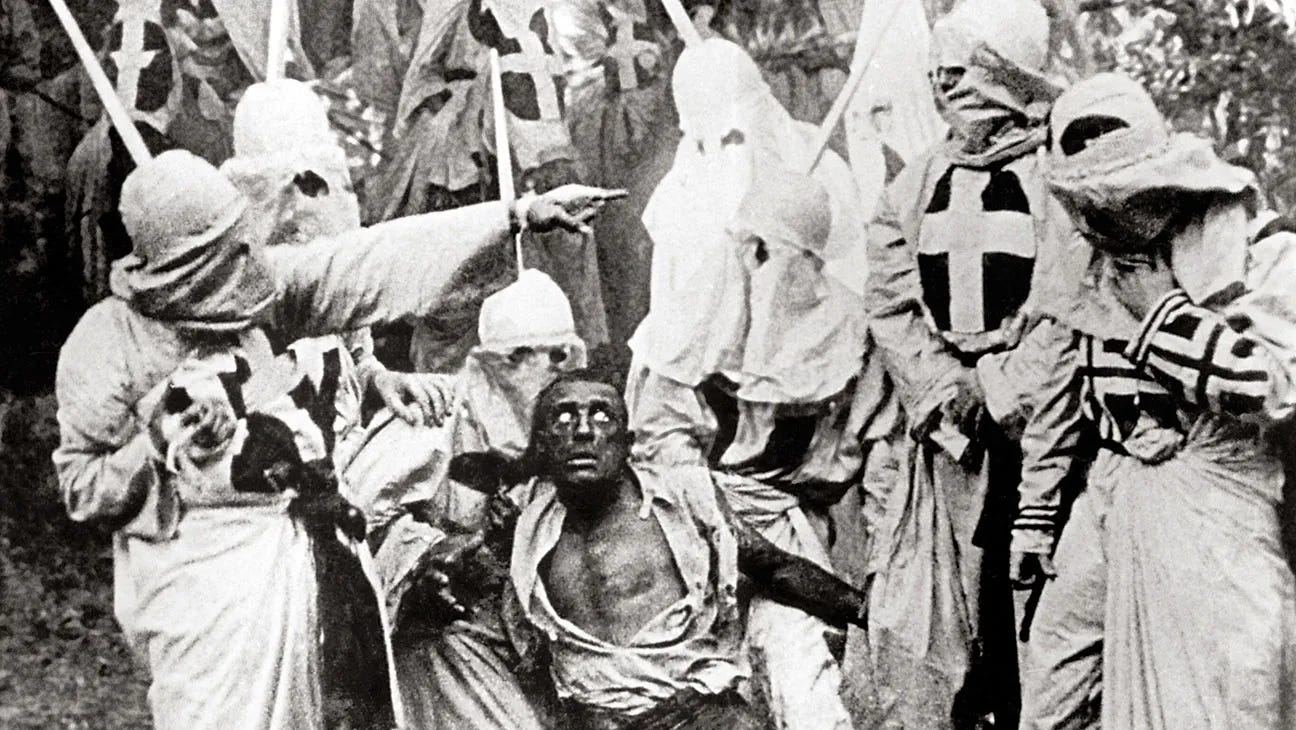
When film emerged as a dominant medium, it inherited this logic and expanded it.
D.W. Griffith’s The Birth of a Nation (1915) did more than tell a racist story. It helped codify the grammar of American cinema — cross-cutting, close-ups, narrative suspense — in service of racial mythology. Black men were framed as threats; white vigilante violence was framed as redemption. A White House screening signaled that cinema could function not only as entertainment but as national pedagogy.
Resistance existed. Oscar Micheaux and other early Black filmmakers produced “race films” that challenged dominant portrayals and depicted Black interiority and class complexity. But their work circulated within segregated theaters and lacked access to the capital and distribution networks controlled by Hollywood’s vertically integrated studio system.
When synchronized sound arrived in the late 1920s, production costs rose dramatically. Corporate consolidation intensified. Independent Black filmmaking, already marginal, was pushed further outside the industrial core. The shift did not invent exclusion; it hardened it.
From its infancy, American cinema positioned Blackness not as full subjectivity but as social problem — danger, disruption, excess. These narrative habits became craft conventions. What began as propaganda settled into tradition.
The Exploitation of the Minstrel
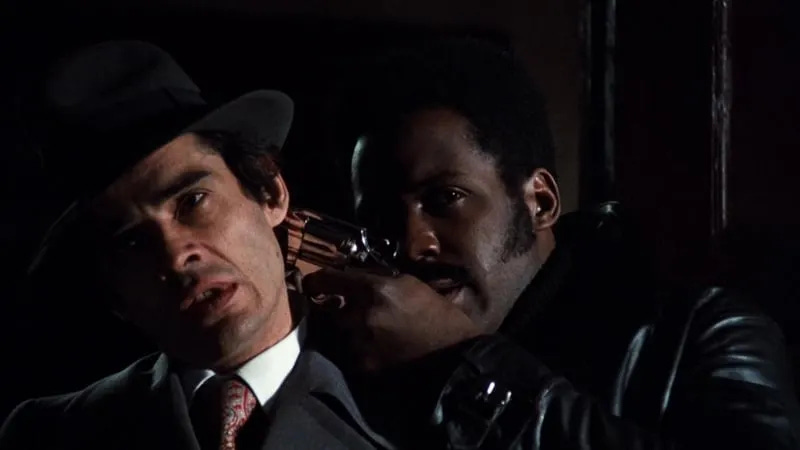
After the Civil Rights Movement, the greasepaint washed off. The system did not.
Overt caricature became unfashionable. But the function of minstrelsy — to naturalize racial hierarchy — simply changed costume. It put on a lab coat and picked up a clipboard.
The “Sambo” became the criminal. The “Buck” became the predator. The “mammy” became the welfare queen.
These figures were no longer presented as jokes. They were presented as data — crime statistics, sociological findings, objective reporting. Television news and police procedurals rehearsed the same images nightly: urban danger, broken families, endemic violence. Structural forces — redlining, de-industrialization, mass incarceration — faded into the background.
As Herman Gray notes, representation shifted into regulation. Blackness was no longer mocked;3 it was diagnosed. Michelle Alexander demonstrates how this re-framing allowed racial hierarchy to survive by translating prejudice into policy4. The language changed. The outcome did not.
Trauma as Spectacle
The next evolution learned that Black pain could be a more potent, and palatable, commodity than Black joy or complexity. The minstrel learned to cry.

The next evolution discovered that Black pain was more profitable — and more palatable — than Black complexity.
We now live in an economy of viral Black suffering. Body-cam footage. Cellphone videos. Death replayed in loops across timelines and cable news. These images are framed as necessary, as awareness, as progress through exposure.
But as Christina Sharpe argues, hyper-visibility is not freedom. It is a form of capture.
The spectacle of Black death produces outrage without redistribution, mourning without repair. Audiences are offered catharsis — grief, guilt, even tears — without confronting the structures that generate the violence. Suffering becomes proof of sincerity. Witnessing substitutes for action.
Visibility without agency is not representation. It is extraction. Pain becomes content. Grief becomes currency. The system remains intact.
The Modern Minstrel
Social media promised democratization. Instead, it crowd-sourced performance. The algorithm is the new stage manager. It rewards what is legible to its training data: proximity to whiteness, Eurocentric beauty standards, palatable anger, consumable trauma. “Authenticity” is measured in metrics shaped by historical bias.
Black creators are not free agents in a neutral marketplace. They operate inside a system trained on centuries of distortion. The lane is narrow. Deviation is expensive.
Artificial intelligence is the logical extension of this arc. AI does not invent; it interpolates. It optimizes.
When image generators associate professionalism with whiteness or danger with Blackness, they are not malfunctioning. They are formalizing historical correlation. Their training data is the accumulated archive of American media — film, news, internet — all layered atop minstrel logic.
As Kate Crawford argues, AI scales the world as it has been, not as it should be.5
A common rebuttal insists: “But this is what people consume.” That argument ignores authorship. Media ownership, distribution, and algorithmic amplification have never been evenly distributed. Selective visibility is not neutral reflection. It is constraint disguised as choice.
If Blackness is repeatedly cast as antagonist, the issue is not pathology. It is power — who holds the pen, the camera, and now the code.
Closing Thoughts
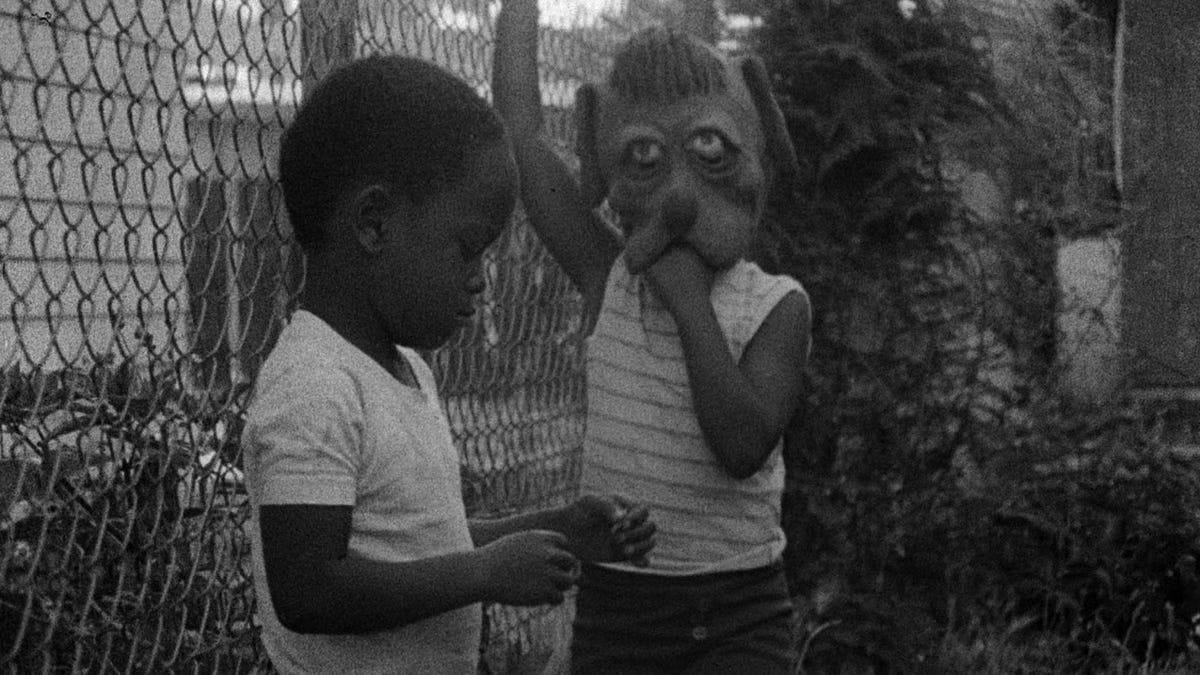
Minstrelsy persists because it works. It has always been profitable, psychologically reassuring, and politically useful. It is not an accident of history. It is an adaptive system. And most Americans have grown up inside it.
If you are white, you did not inherit these images as “racist.” You inherited them as normal. The criminal on the evening news. The danger in the city. The sidekick. The suspect. The viral video of death. The mugshot that circulates faster than the graduation photo. None of it felt coordinated. It felt like reality.
That is how systems survive — by presenting repetition as coincidence.
More representation inside that framework does not undo it. It simply refreshes the casting. The deeper question is structural: who owns the platforms, who controls distribution, who designs the algorithms, and whose archive trains the machines.
An algorithm trained on a distorted past cannot generate a neutral future simply by declaring itself objective. If Blackness is repeatedly cast as antagonist, pathology, or spectacle, the issue is not behavior. It is authorship.
And if you recognize the pattern — if you can trace it from blackface to blockbuster to body-cam to algorithm — then you were never watching isolated incidents. You were watching a system. And the uncomfortable truth is this: it worked so well you thought it was just the way the world was.
References
Lott, Eric. Love and Theft: Blackface Minstrelsy and the American Working Class. New York: Oxford University Press, 1993.
Kern-Foxworth, Marilyn, and Maurice Manring. Slave in a Box: The Strange Career of Aunt Jemima. Charlottesville: University of Virginia Press, 1998.
Gray, Herman. Watching Race: Television and the Struggle for “Blackness.” Minneapolis: University of Minnesota Press, 1995.
Alexander, Michelle. The New Jim Crow: Mass Incarceration in the Age of Colorblindness. New York: The New Press, 2010.
Crawford, Kate. Atlas of AI: Power, Politics, and the Planetary Costs of Artificial Intelligence. New Haven: Yale University Press, 2021.
This is a great read Derrick.
You’re right. We have definitely been watching a SYSTEM…and one not built for us.