

The Authenticity Trap: When Reality Becomes Optional
Living in the Age of Fabricated Reality


Imagine getting a video call from someone you loved and lost a husband, an old friend, a parent. They speak your language, laugh at your jokes, remember moments only you shared. For a few heartbeats, it feels real — heartbreakingly real. You reach for them, but they aren’t there; they’re long gone from this world. What you’re seeing, hearing, and feeling is entirely manufactured. This is the edge of what I call the Singularity of Fabrication — a moment where AI-generated experiences become indistinguishable from lived reality.
This may seem like I am describing The Matrix, or rehashing a point from a previous essay. But unlike fiction, or theory, this is happening now. What we once relied on as “real” — our memories, our interactions, our evidence of the world — is now negotiable. Algorithms can shape not just what we see, but what we feel. Our perception of reality is bending in real time, and the consequences are existential.

Seeing the Synthetic
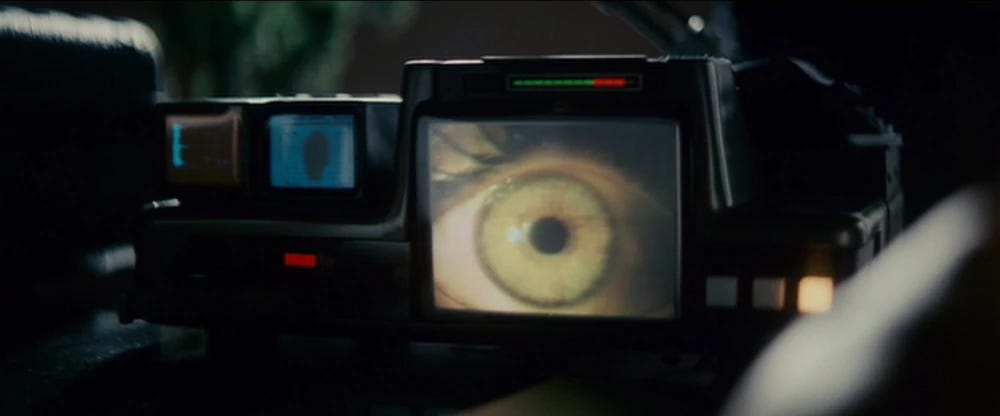
Blade Runner imagined this tension decades ago. Replicants, with memories they never lived, force humans to question what it means to be alive, to remember, to know the truth. Westworld shows hosts whose experiences blur the line between programming and consciousness. Even in The Mandalorian, audiences form deep bonds with entirely constructed realities. These stories are no longer just entertainment; they are mirrors of our evolving perceptual landscape.
Walter Benjamin once wrote about the “aura” of original works of art — their unique presence in time and space, and their authenticity — and how mass reproduction diminishes that aura. AI goes further. It doesn’t just reproduce; it fabricates new “originals”: a Van Gogh that never existed, a childhood memory you never lived, a voice that never spoke. The distinction between copy and original collapses. Aura, authenticity, lived experience — all become negotiable concepts. Replicants in Blade Runner carry that same tension: their memories feel authentic, but their foundation is artificial.
The technology driving this collapse is already here. AI is already generating text, images, audio, and video that feel coherent, real, and emotionally resonant. Multi-modal AI creates internally consistent worlds: what you read, see, and hear aligns perfectly. Feedback loops refine the outputs until they are indistinguishable from reality. Humans, wired to respond to narrative plausibility rather than objective truth, are built for this. We trust stories, not pixels, and AI exploits that instinct effortlessly.

Society-Scale Perceptual Uncertainty
The cognitive implications are profound. In clinical psychology, schizophrenia involves a disruption in reality monitoring: the brain’s ability to distinguish between internally generated thoughts and external events. Deficits in this system, often involving the prefrontal cortex and hippocampus, can make it difficult to separate hallucination from reality. Today, AI is activating similar mechanisms — not in individuals, but collectively. Flooded with synthetic content, reinforced by social consensus and repetition, we are all navigating a reality where perception is under constant negotiation, questioning reality in front of us. This is not mental illness; it is society-scale perceptual uncertainty.

And here is where it becomes existential. “Living your truth” has always worked because reality pushed back. There were consequences, limitations, a world outside your perception. Today, parts of that reality are fabricated. Memories, interactions, and media may feel real, but the foundation is synthetic. If you live authentically — acting with intention, empathy, or moral coherence — what does authenticity even mean when the world itself can hallucinate? The AI doesn’t just simulate reality; it reprograms the scaffolding of our lived experience.
The stakes are enormous. If any memory, statement, or event can be fabricated, who decides what counts as true? Journalism, history, justice, and identity are all negotiable. AI is the middleman of perception, filtering and shaping reality itself. Emotions can be manipulated, grief exploited, desires commodified. Benjamin’s aura has been replaced by plausibility: the perfect simulation can feel more real than the messy, human original.
Living Authentically in a Hallucinated World
We are all Blade Runners now, questioning every shadow, every face, every voice. But unlike him, our eyes and the uncanny valley are our only Voight-Kampff test. Reality used to be external, stable, and shared. Now it is fluid, negotiated between our own perception, social consensus, and powerful AI systems. Authenticity no longer relies solely on objective reality; it may have to emerge from intentionality, coherence, and ethical engagement with a world that can fabricate itself.
The Singularity of Fabrication is not a distant horizon. It is unfolding in feeds, calls, images, and simulations. It offers opportunity: new art, new stories, new ways of connecting with each other and the past. But it also asks a fundamental question: if reality can be hallucinated, how do we live authentically? How do we anchor ourselves when the very ground beneath “real” is in flux?
Perhaps authenticity will be a negotiation — an emergent property of intention, ethics, and awareness — rather than a guarantee grounded in reality. Or perhaps we will redefine what it even means to be human.

Sources and References
Film & TV
Blade Runner. Directed by Ridley Scott, performances by Harrison Ford, Rutger Hauer, and Sean Young, Warner Bros., 1982.
The Mandalorian. Created by Jon Favreau, performances by Pedro Pascal and Giancarlo Esposito, Lucasfilm/Disney+, 2019–present.
The Matrix. Directed by Lana Wachowski and Lilly Wachowski, performances by Keanu Reeves and Laurence Fishburne, Warner Bros., 1999.
Westworld. Created by Jonathan Nolan and Lisa Joy, performances by Evan Rachel Wood and Jeffrey Wright, HBO, 2016–2022.
Books & Essays
Benjamin, Walter. The Work of Art in the Age of Mechanical Reproduction. 1936. In Illuminations, edited by Hannah Arendt, translated by Harry Zohn, Schocken Books, 1969, pp. 217–251.
Frith, Christopher D. The Cognitive Neuropsychology of Schizophrenia. Lawrence Erlbaum Associates, 1992.
Journal Articles
Lewandowsky, Stephan, Ullrich K. H. Ecker, and John Cook. “Beyond Misinformation: Understanding and Coping with the ‘Post-Truth’ Era.” Journal of Applied Research in Memory and Cognition, vol. 6, no. 4, 2017, pp. 353–369.